 Trust
TrustWeak device identity
Keys generated in software, shared across platforms, or verified only at the network layer. No hardware trust root means identity can be cloned or forged without physical access.
nRF52840 · ATECC608A · Thread · HPKE · MCUboot
Telemetry is signed in secure hardware and encrypted on the sensor before it enters the network. The gateway verifies and forwards, but cannot decrypt. Plaintext appears only inside a controlled cloud boundary that can be deployed in European or customer-controlled environments.
End-to-end means the gateway is outside the confidentiality boundary — and decryption stays inside infrastructure you control.
The problem
Many industrial IoT platforms encrypt data in transit but terminate encryption at the gateway or edge processor. Plaintext appears at the first aggregation point — the same box that routes, buffers, and integrates data. That widens compliance scope, concentrates insider risk, and creates audit problems that no amount of TLS can resolve. For many EU and German buyers, this is not only a security problem but a sovereignty problem: the more systems that can see plaintext telemetry, the larger the operational, contractual, and jurisdictional exposure.
Keys generated in software, shared across platforms, or verified only at the network layer. No hardware trust root means identity can be cloned or forged without physical access.
TLS terminates at the gateway. From there, telemetry is in the clear — exposed to every integration, log stream, and operator session on the edge device.
When the gateway can read customer data, it enters scope for every regulation, audit, and breach notification framework — even if it adds no analytical value.
Many IoT platforms stop at transport. Firmware updates, rollback safety, and device lifecycle tracking are left to manual scripts and hope.
The TrustKern approach
ECDSA P-256 signing key generated and held on-chip. Private key never visible to firmware, JTAG, or any external interface.
Devices are commissioned over BLE GATT via the iOS app. BLE is disabled after provisioning. All operational telemetry flows over Thread 802.15.4 mesh.
Every message is a deterministic CBOR envelope — signed with the hardware key and encrypted with HPKE. The gateway receives ciphertext only.
Signatures and anti-replay checked at the gateway, then checked again at the collector. Two independent verification points before any data is stored.
How TrustKern works
Nine steps, three trust boundaries. The gateway sits between the device and cloud boundaries — transporting and verifying, but never decrypting.
Sensor board — nRF52840 SoC + ATECC608A secure element. Signing key generated on-chip and never exportable. Payload encrypted with HPKE before leaving the device. BME688 environmental + BMI270 motion sensors.
Edge relay — Raspberry Pi with OTBR for Thread border routing + tk-gateway application. Verifies ECDSA signatures, enforces boot_id/seq anti-replay, publishes raw encrypted envelopes over MQTTS. No decryption keys, no plaintext access.
Cloud ingestion — Collector verifies signatures again (defense-in-depth), opens HPKE ciphertext, parses sensor JSON payload, persists to TimescaleDB, and updates device lifecycle state.
Trust boundary architecture
TrustKern trust boundary architecture — three boundaries, one controlled decryption point.
Why TrustKern
Sovereignty-first architecture
In regulated European environments, the main question is often not only whether data is encrypted, but where plaintext appears, who operates the systems that can access it, and under which legal and contractual boundaries those systems run. TrustKern is designed to reduce exposure at intermediary layers and support deployment models where decryption and storage stay inside infrastructure chosen and controlled by the customer.
The gateway relays and verifies, but does not become a plaintext processing point. Fewer systems with access to sensitive data means a smaller operational, contractual, and jurisdictional footprint.
Plaintext appears only in a cloud-side boundary selected by the deployment model. Decryption scope can be aligned with audit, data residency, and contractual requirements.
Suitable for EU-hosted, customer-controlled, or self-hosted environments. The core trust model does not change when the hosting model changes.
Deployment models
Three deployment postures, one trust model — decryption always stays inside the boundary you choose.
Architecture comparison
Core capabilities
ECDSA P-256 keypair in ATECC608A slot 0. On-chip generation, non-exportable private key, PoP-based onboarding.
GATT service for identity read + provisioning write via iOS app. Backend-signed bundles. BLE radio disabled after commissioning.
IEEE 802.15.4 low-power mesh. Sleepy end devices with configurable poll periods. Designed for battery-operated, dense deployments.
HPKE (X25519 + AES-128-GCM) encrypted payload inside signed CBOR envelope. Gateway never holds decryption keys.
Deterministic CBOR wire format with version, sensor ID, boot_id, seq, timestamp, flags, ciphertext, and ECDSA signature.
Signature verification and anti-replay at the gateway (first check) and collector (second check). Two independent enforcement points.
boot_id (monotonic across reboots) + seq (monotonic within boot). Gateway and collector both enforce ordering independently.
Per-sensor health tracking, gateway heartbeats, firmware version tracking, and operational metrics — without exposing plaintext at the edge.
MCUboot dual-slot bootloader, signed firmware, staged rollouts, health-gated confirmation, and automatic rollback.
Real telemetry, real dashboards
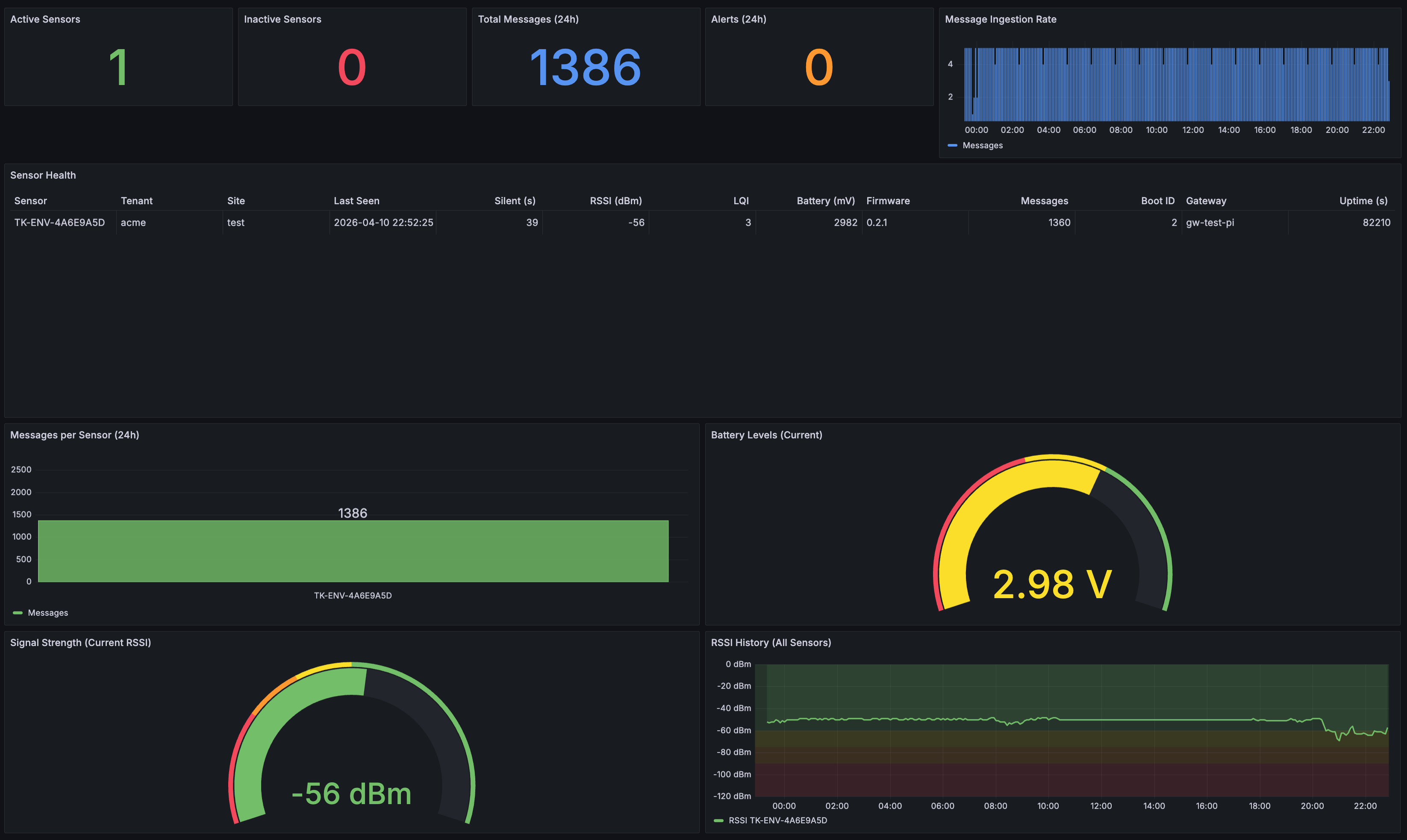
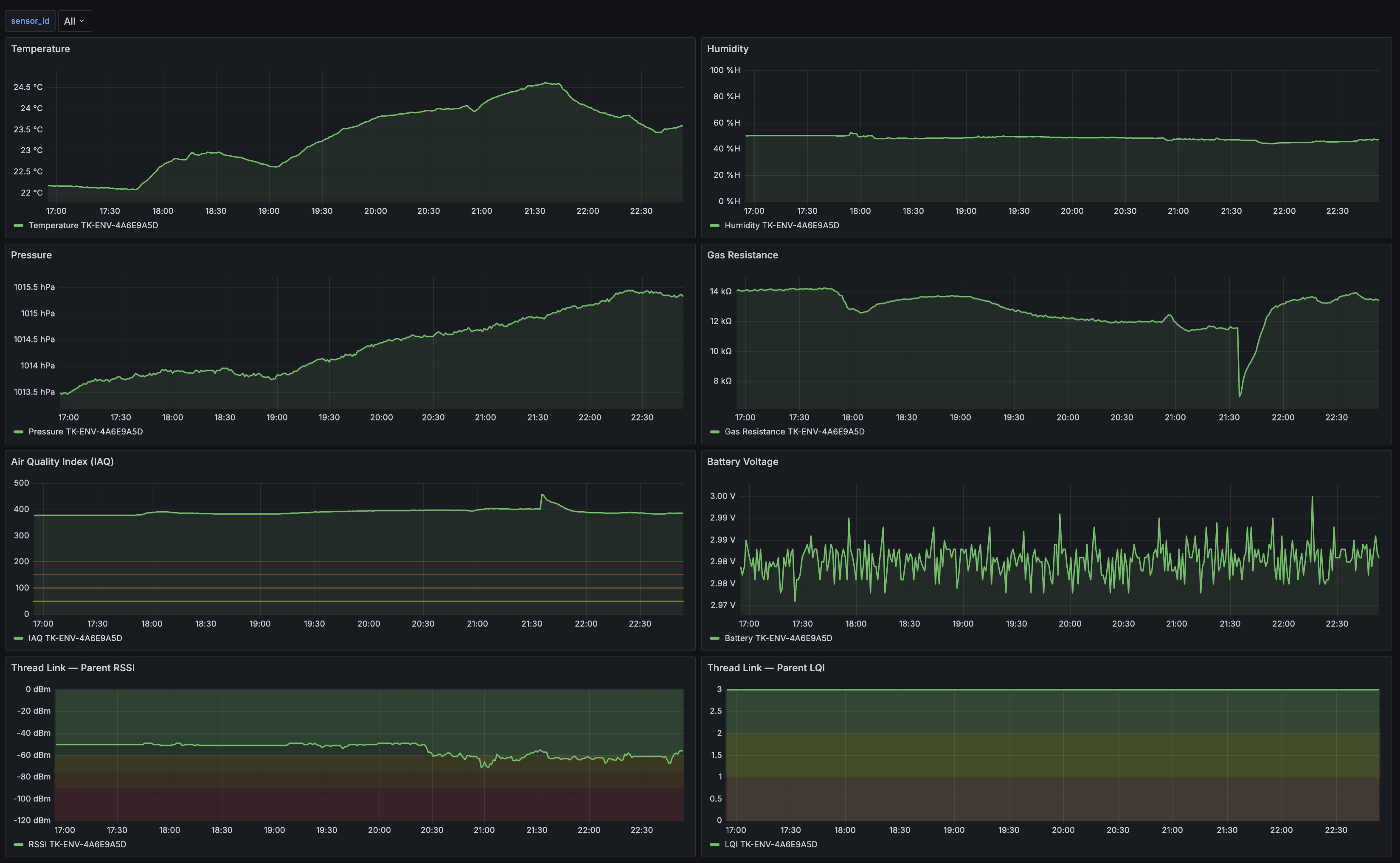
Production data from a TrustKern sensor fleet — decrypted and visualized only inside the controlled cloud boundary. The gateway never sees this data in plaintext.
OTA & fleet lifecycle
Long-lived industrial fleets need managed firmware delivery, safe rollback, and per-device lifecycle tracking — not manual reflashing over serial cables.
A/B image slots with swap-based upgrade. New firmware boots in test mode — confirmed only after health checks pass. Automatic revert if confirmation fails.
ECDSA-P256 signed images. Separate production and development signing keys. Unsigned images rejected by MCUboot before execution.
Lab → production rings with per-device status tracking. Auto-pause on failure thresholds. Operator-controlled promotion between rings.
Backend tracks firmware version, rollout state, boot history, and health per sensor. Gateway drives MCUmgr upload over Thread. Collector updates status from OTA events.
Rollout lifecycle
Health-gated confirmation per device, staged rollout across fleet rings. Auto-pause and rollback on failure.
Where it fits
Organizations where the edge gateway must not be a decryption point — and where device provenance, auditability, and fleet lifecycle are operational requirements.
Environmental and process monitoring in multi-vendor plant environments. Gateway-blind encryption keeps shop-floor telemetry out of shared edge infrastructure.
Reduced blast radius when relay compromise does not expose bulk sensor data. Hardware-backed device identity for accountability across distributed assets.
Battery-operated mesh sensors with long deployment lifetimes. OTA-capable architecture for strict change management and verifiable software lifecycle.
Environmental monitoring and instrument telemetry in hybrid trust environments. Minimizing plaintext at the edge supports governance models that justify every processing step.
Condition telemetry through third-party relay hubs. End-to-end ciphertext reduces reliance on intermediaries' security posture. Cryptographic device provenance for chain-of-custody.
Architectures that plan for hostile intermediaries. Payloads remain sealed until explicitly opened inside controlled decryption boundaries.
Security & governance
TrustKern is designed for regulated environments. Specific certifications depend on your deployment, jurisdiction, and threat model.
No fabricated certification badges, customer logos, or compliance metrics on this page. Security claims are architectural. Your assurance posture is implemented with your legal and security teams.
Deployment
TrustKern supports deployment models where security and jurisdictional control matter at the same time. Gateway components remain outside the payload confidentiality boundary, while cloud-side ingestion and decryption can be placed in infrastructure selected by the customer. This supports EU-hosted, customer-controlled, or self-hosted operating models without changing the core trust model.
Deploy cloud components in European infrastructure with controlled operational boundaries. Edge gateway on Raspberry Pi + OTBR, cloud stack via Docker Compose — backend, collector, Mosquitto, TimescaleDB, step-ca, Grafana.
Place ingestion and decryption inside infrastructure operated or owned by the customer. The trust model stays the same — the gateway still cannot decrypt, and decryption keys remain inside your boundary.
Run the platform in private environments where data governance and operator access need tighter control. All components are containerized and designed for air-gapped or restricted-network operation.
Get started
Sovereignty-focused architecture walkthrough, EU and customer-controlled deployment options, or integration planning for regulated environments.
Secure element identity, gateway-blind path, controlled decryption boundary, OTA lifecycle, and EU or customer-controlled deployment models.
Or reach us at info@trustkern.de
For partnerships, procurement, and media inquiries.
Engineering & security teams: Structured context helps — threat model, target regions, sovereignty requirements, integration constraints, fleet size.
See how TrustKern fits regulated environments with EU-hosted, customer-controlled, or self-hosted deployment.